

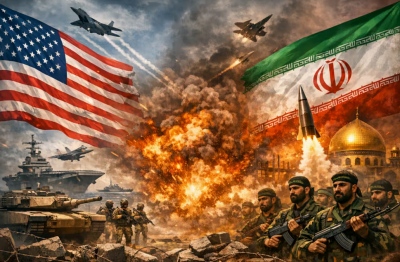
Iran is now acting as the regulator of negotiation terms with the Americans, having not only rejected the "farce" proposals of the US but also proposing a 3-phase dialogue formula for negotiations to commence. Meanwhile, the threats from Donald Trump, who issued an ultimatum stating that if no agreement is reached in 3 days he will burn Iran's entire oil system, are seen more as verbal acrobatics and hyperbole than the start of a new round of war. Iran has warned that if its oil industry is hit, it will dismantle all oil-producing Gulf nations and demolish Israel. Nevertheless, only Brent crude is being affected by this climate of instability, currently trading at $107 per barrel.
The 3-phase dialogue plan proposed by Iran: Each step requires agreement to proceed to the next stage
Iran has presented a 3-phase negotiating formula to the United States through intermediaries, according to the Al Mayadeen television network. "Iran has notified mediators of a 3-phase negotiation scheme and, if the US accepts it, Iran will conduct negotiations accordingly," reports Al Mayadeen. A key prerequisite for the process to move to the next stage is an agreement on the previous stage, ensuring that the US does not deceive the Iranians.
First stage: Ending the war
According to the initiative, the first stage of negotiations should focus on ending the war and securing guarantees to refrain from further military action against Iran and Lebanon.
Second stage: Management of Hormuz
If an agreement is reached, the parties should proceed to the second stage, which will involve discussing how to manage the Strait of Hormuz after the end of the war, in coordination with the Omani side "to create a new legal system."
Third stage: Nuclear issues
The transition to the third stage, related to the discussion of Iran's nuclear program, will not take place without reaching an agreement on the first and second stages, Al Mayadeen claims. Axios also reported, citing a US official and two other informed sources, that Iran had conveyed a proposal via Pakistani mediators that would open the Strait of Hormuz and eventually resolve the conflict, postponing discussions on the nuclear issue to a later date. The Iranian Foreign Minister reportedly told mediators that there is no consensus within the leadership of the Islamic Republic regarding US demands to stop uranium enrichment and remove it from the country.
US President Donald Trump announced that he canceled the American delegation's trip to Islamabad for talks with Iran. Later that same day, he claimed the United States received a new offer from Tehran with more favorable terms. Iran, however, initially denied plans for a meeting with the Americans. In turn, the Iranian president, in a conversation with the Pakistani prime minister, stated that the country will not participate in peace talks under pressure, threats, or a maritime blockade.
Trump ultimatum: I will destroy Iran's oil system in 3 days – Iran threatened Israel with nuclear holocaust "in minutes"
US President Donald Trump stated that the United States will take control of Iran's nuclear materials as part of the negotiations. He pointed out that Israel would be destroyed "within minutes" if Iran acquired a nuclear weapon, warning that the entire world would be at risk. He added that previous American administrations should have acted sooner to stop Iran's nuclear ambitions. He also noted that Iran's oil system could "explode" within three days if supply disruptions continue, describing a scenario in which blocking the flow of oil would cause pressure to build up in pipelines and underground systems.
Donald Trump mentioned in statements to Fox News that if oil cannot be transported, it continues to accumulate "mechanically and in the ground," which could lead to a network rupture or explosion causing permanent damage to the system. He added that even if rebuilt, the infrastructure would likely only return to about "50%" of its current capacity, describing the result as "very, very... powerful." Simultaneously, he criticized NATO for its stance on the conflict with Iran, arguing that the Alliance did not support Washington. In his statements to Fox News, Trump mentioned that "NATO was not there for us," adding that Britain had stated it would send ships only after the war ended. "That is not good," he commented characteristically. Trump stated that some of the figures Washington is talking to within the framework of contacts with Iran are "very reasonable," while others are not, expressing hope that Tehran "will be smart." Furthermore, he underlined that if Iran wishes to negotiate, "they can call us," clarifying that any talks could be conducted by telephone.
Araghchi (Iran Foreign Minister) in Russia: Critical meetings with Putin, Lavrov
Iranian Foreign Minister Abbas Araghchi stated that his trip to Saint Petersburg, where he is set to meet with Russian President Vladimir Putin, "is a good opportunity for us to consult with our Russian colleagues regarding developments related to the war." "As you know, we always hold meetings with Russia to discuss broader issues, particularly regional and international matters, and of course, many issues are always raised within the framework of our bilateral relations," Abbas Araghchi said in a video interview published by the Iranian state agency IRNA shortly after his arrival in Russia on Monday.
Before reaching Russia on Monday, Abbas Araghchi met over the weekend with key mediators in Pakistan and Oman. He stated that in Pakistan, they discussed the conditions under which Iran–US talks can be resumed. "I had good consultations with our friends in Pakistan; the visit was successful. We examined what has happened so far in the negotiations and the conditions under which they can continue," Araghchi reported. During his stay in Oman, Abbas Araghchi stated they discussed their shared interests in the Strait of Hormuz. "Safe passage through the Straits of Hormuz is now a major global issue and, of course, we must engage in dialogue with the coastal states of this waterway so that our common interests are ensured and we remain coordinated in any actions," the Iranian Foreign Minister emphasized.
Mohammad Bagher Ghalibaf: Iran holds all the cards, the US has simply run out and stands no chance
The Speaker of the Iranian Parliament, Mohammad Bagher Ghalibaf, in his latest post, published an equation of the economic cards held by Iran and the United States, showing that, contrary to Trump's claim, America has run out of cards and Iran still has many to play. He examined these cards, noting that they talk a lot about their own cards.
Supply cards (Iran):
-
Strait of Hormuz (this card has been partially played)
-
Bab-el-Mandeb Strait is an extremely strategic strait connecting the Red Sea with the Gulf of Aden and the Indian Ocean (has not been played yet)
-
Oil pipelines (have not yet been played as a card)
Demand cards (US):
-
Releasing strategic oil reserves to manage the market (is being played)
-
Managing consumption and reducing oil demand (they have played a role to some extent)
-
And now they are passively waiting for price increases
The Speaker of the House, Mohammad Bagher Ghalibaf, wrote, referring to America's economic constraints: "You should also add to this list the increased energy demand for summer vacations in America, unless they want to cancel them in America!"
Israel Hayom: Netanyahu blames the IDF for failures in Lebanon and Mossad for Iran
Dissatisfaction with the actions of Prime Minister Netanyahu is growing among Israeli military personnel. According to Israel Hayom, this is due to Netanyahu's intention to blame them for all failures with Iran and Lebanon. "Military dissatisfaction is only the tip of the iceberg of a growing feeling within the Israel Defense Forces that he is seeking a scapegoat to hold responsible for the disappointing results in Lebanon and the partial results in Iran," reports Israel Hayom. According to the newspaper, the prime minister intends to blame Mossad for the failed attack on Iran. He plans to shift the blame for the failure in Lebanon onto the IDF. Earlier, Israeli Prime Minister Netanyahu ordered the Israel Defense Forces to launch powerful strikes against Hezbollah targets in Lebanon.
The negotiation deadlock
Recent diplomatic contacts between the United States and Iran have not led to substantial progress. The reasons are deeper and related to fundamental disagreements. Tehran considers Washington's stance "maximalist," while the United States considers Iranian demands unacceptable. This mutual distrust makes any agreement extremely difficult. Iran sets a reasonable condition to restart dialogue: that the naval blockade be lifted. However, the American side also appears to be in no hurry to restart talks.
The Iranian Foreign Minister, Abbas Araghchi, carried out a diplomatic tour with an intermediate stop in Islamabad, returning from Oman. There, he is expected to continue contacts with Pakistan, which has taken on the role of mediator. Despite the lack of progress, Pakistan insists that the process has not ended. Diplomatic mobility continues.
Iran: Araghchi's return to Pakistan unrelated to nuclear program negotiations
The return of Iranian Foreign Minister Abbas Araghchi to Pakistan is not linked to nuclear negotiations with the US, but is part of a broader framework of regional consultations, Tehran clarifies. According to Tasnim, Araghchi carried out a tour that included Pakistan, Oman, and Russia. The central goal of the contacts was, beyond bilateral relations, the transfer of Iran's positions regarding ending the conflict in the region, with Pakistan playing a mediatory role. Included on the agenda are issues such as the new legal status in the Strait of Hormuz, compensation for damages, guarantees to avoid military aggression, and the lifting of the naval blockade. The next stop for the Iranian Foreign Minister is Russia, which remains a critical diplomatic ally for Tehran. Indeed, Araghchi will have a meeting with the Russian leader Vladimir Putin.
Araghchi (Iran Foreign Minister): The US is a source of instability for the Middle East
Araghchi paid a visit to Muscat, where he met with the Sultan of Oman, Haitham bin Tariq Al Said. The meeting took place during a period of increased tensions, with the primary subject being the security of navigation in Hormuz—a vital passage for global energy trade. Abbas Araghchi expressed Tehran's appreciation for Oman's role as a responsible mediator, underlining the importance of diplomacy in a period of intense geopolitical instability. Simultaneously, he reiterated Iran's will to maintain close relations with the countries of the southern Persian Gulf, promoting a model of regional cooperation without external interventions. The Iranian side argued that the presence of US military forces in the Middle East is a factor of instability and division, calling for a more autonomous approach to security.
Iran responds dynamically in Hormuz with seizure of two ships linked to Israel
In a move of high symbolism and strategic tension, Iran proceeded with the seizure of two ships linked to Israel in the Strait of Hormuz, sharply escalating the conflict with the United States and its allies. The operation was carried out by forces of the Islamic Revolutionary Guard Corps (IRGC), who utilized information from drones and surveillance systems to locate the ships MSC Francesca and Epaminondas, which—according to Iranian sources—were attempting to cross the area with tracking systems turned off and misleading flags.
Pushkov (Russian Senator): Military campaign against Iran insufficient, the US was not ready
The US military campaign against Iran was insufficiently prepared, as it was based on the mistaken belief that quick results could be achieved through the use of force, argued Alexey Pushkov, chairman of the Committee on Information Policy and Media Relations of the Federation Council. In an interview with TASS, Pushkov argued that "from a military point of view, the current campaign was obviously insufficiently prepared."
In his view, the US approach may have been influenced by their experience in Venezuela, which Washington may have seen as an example of the effectiveness of "precise and surgical" operations. "The kidnapping of Venezuelan President Nicolas Maduro and the very weak reaction of the Venezuelans, who chose to accept US terms regarding the control of the country's oil exports, convinced Trump that a 'surgical' precision military operation is a good tool to force a foreign regime to behave as the US desires. After that, Trump obviously decided that something similar could be done in Iran," the senator noted.
www.bankingnews.gr








Σχόλια αναγνωστών